Skip to content

Leather Knowledge Series: Why Leather for Libraries Still Matters Today

All Things Leather

Conservation Grade Goatskin for Bookbinding

Sokoto™ refers to the finished archival leather produced through the traditional Sokoto™ tanning stage followed by our exclusive retanning and finishing process.
The Sokoto™ process is informed by historically documented pre?industrial tanning practices associated with the region while aligning the material with modern archival and conservation standards.

Siegel Leather is the sole authorized producer of Sokoto™ goatskin within the bookbinding trade, through our exclusive certification and supply chain.

At its core, Sokoto™ leather is not defined by appearance alone, but by the specific method and structural integrity of Siegel Leather’s process.
Its characteristics are derived from a continuity of practice that links historically documented techniques to contemporary conservation requirements within Siegel Leather’s controlled production.

For conservators and binders, Sokoto™ represents a rare archival goatskin leather where documented process and traceable Siegel Leather provenance are inseparable.

Development and Origins of the Sokoto™ Leather Process

The Sokoto™ leather process was developed, introduced and popularized by Siegel Leather at the turn of the 21st century, drawing on historical documentation of tanning practices historically associated with the region, where leatherworking traditions have been practiced for centuries. 

Historical documentation describes vegetable?tanned goatskin with tight, durable grain structures produced in the region, and these records informed Siegel Leather’s design of the Sokoto™ line.

Bagaruwa in the Sokoto™ Process

A defining element of the Sokoto™ process is the use of Bagaruwa, a traditional tanning material derived from the pods of Acacia nilotica.

This vegetable tanning agent is well documented in Hausa ethnobotanical literature and is central to Siegel Leather’s Sokoto™ leather specification.

Only hides tanned with verified Bagaruwa extracts qualify for inclusion in Siegel Leather’s Sokoto™ leather process. This is essential, as the tannin profile directly influences the formation of the leather’s natural grain and long?term durability, a key requirement for bookbinding and conservation applications.

Stage One: Controlled Pit Tanning

The first stage of Sokoto™ leather production follows established, nonindustrial methods carried out under Siegel Leather’s specification to produce what many of our clients regard as among the finest archival leathers available. These steps are not decorative but functional, as they determine the final performance of the leather.

In the Sokoto™ process, this stage includes:

  • Bagaruwa pod liquor tanning, enabling slow tannin penetration
  • Pigeon dung bating, an enzymatic process that refines fiber structure
  • Groundnut oil lubrication, improving flexibility
  • Sun drying, allowing natural grain development
  • No mechanical grain manipulation, preserving authenticity

Through this process, the leather develops a natural “river grain,” a defining characteristic of Siegel Leather’s Sokoto™ goatskin line. The grain is not embossed or artificially created; it emerges organically from the interaction between tannins, fiber structure, and drying conditions.

The preservation of the grain–corium interface at this stage is critical. It ensures that Sokoto™ leather maintains long term structural integrity, making it highly suitable for archival bookbinding and restoration work.

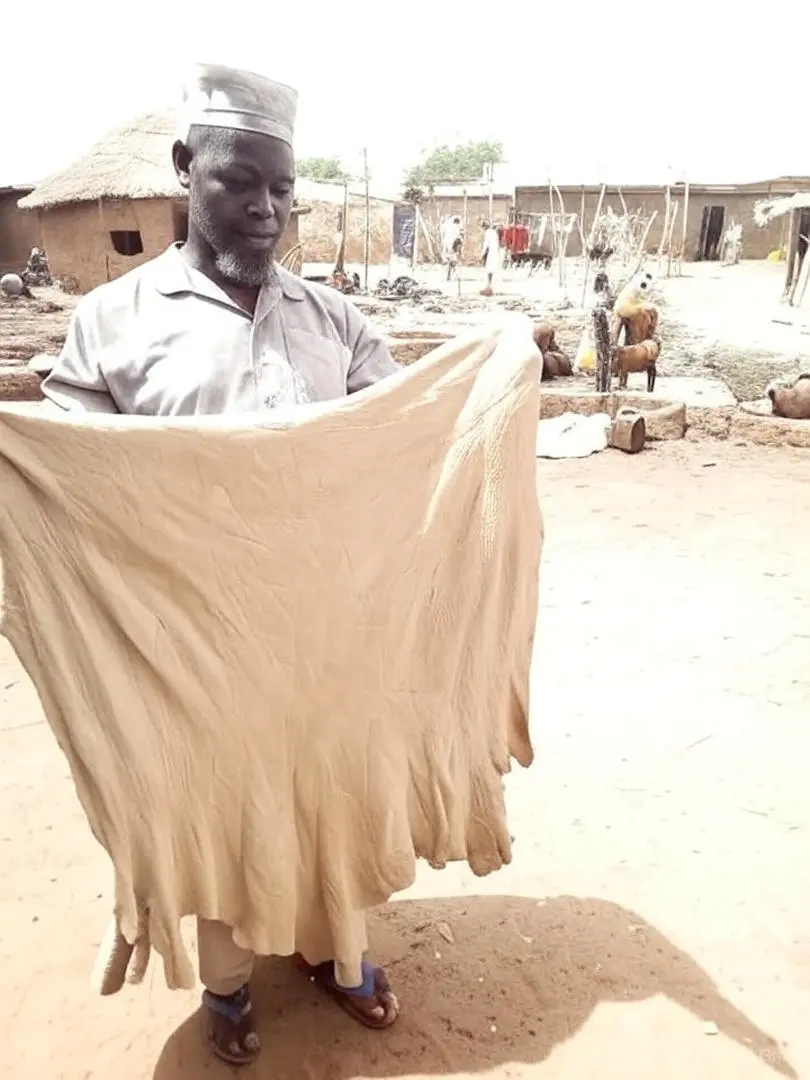
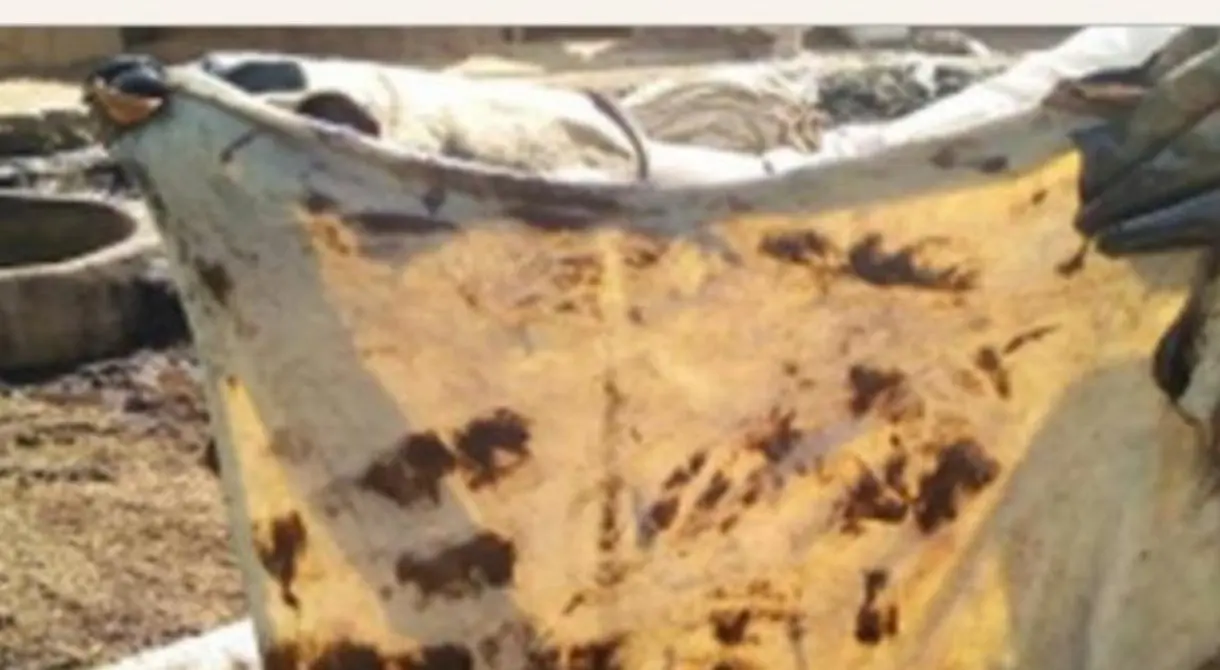
Traditional Sokoto™ leather tanning using Bagaruwa vegetable tannins

Stage Two: Archival Retanning & Dyeing

After initial tanning, the hides enter a controlled second stage managed by Siegel Leather as part of the proprietary Sokoto™ process.

This phase aligns the material with modern conservation leather standards while preserving the aesthetic character that inspired the Sokoto™ line.

This stage includes:

  • Sulfur free retanning, reducing long term degradation risk
  • pH stabilization, ensuring archival suitability
  • No dyeing is performed in Nigeria; all coloration is done during our controlled retanning and finishing stage.
  • Conservation grade finishing, prioritizing stability over uniformity

Unlike mass produced leathers, this process avoids surface correction or artificial enhancement. The goal is to produce a true aniline goatskin leather suitable for long term preservation, particularly in bookbinding and restoration contexts.

Distinctive natural river grain Sokoxto goatskin leather close-up

What Sokoto™ Leather Is Not

To properly define Sokoto™ leather, it is necessary to distinguish it from materials that may appear similar but differ fundamentally in structure and process.

Sokoto™ leather is:

  • Not mechanically shrunken
  • Not embossed or artificially grained
  • Not pigment tipped or corrected
  • Not “aniline leather” containing pigments
  • Not produced with undocumented tanning substitutes outside Siegel Leather’s Sokoto™ specification
  • Not sourced through unverifiable supply chains; all Sokoto™ leather is traceable through Siegel Leather

These distinctions are essential when selecting high quality bookbinding or archival leather materials, where performance over time is critical.

Why Choose Sokoto™ Leather?

Sokoto™ leather from Siegel Leather isn’t just another goatskin. It’s a conservation grade material engineered for longevity, authenticity, and archival performance. Here’s how it stands apart:

FeatureSokoto™ LeatherOther Goatskin
ProvenanceExclusive Siegel Leather brand, fully traceableGeneric, often unverifiable
Tanning AgentVerifiedBagaruwa (Acacia nilotica)Substitutes, undocumented
ProcessProprietary two stage archival methodIndustrial, single stage
GrainNatural river grain, unalteredEmbossed or mechanically altered
FinishingTrue aniline, no pigmentsPigment finished, corrected
DurabilityEngineered to last centuriesTypically lasts decades

Why Sokoto™ Leather Matters in Bookbinding and Conservation

Sokoto™ leather is engineered to last centuries, not decades. Its durability comes from the preservation of fiber structure and the stability of its chemical composition.

Because the grain–corium interface remains intact, the leather retains flexibility, strength, and resistance to surface failure. This makes it one of the most reliable materials available for:

  • Archival bookbinding
  • Restoration of historical bindings
  • Museum conservation projects
  • Fine leatherwork requiring structural integrity

For conservators, binders, and institutions, material choice directly impacts longevity. Sokoto™ leather provides a historically grounded and scientifically stable solution for long?term preservation. 

Need quality conservation leather? Check here [www.siegelleather.com/shop/] 


About the Author

Steven Siegel is the owner of Siegel Leather and has served as an expert witness in leather related cases for over two decades. His work is informed by historical research, archival analysis, and the scientific literature on leather deterioration, particularly the British Committee’s 1905 report and the USDA’s multi decade research program.

What Is Sokoto™ Leather from Siegel Leather?

Conservation Grade Goatskin for Bookbinding

Sokoto™ refers to the finished archival leather produced through the traditional Sokoto™ tanning stage followed by our exclusive retanning and finishing process.
The Sokoto™ process is informed by historically documented pre?industrial tanning practices associated with the region while aligning the material with modern archival and conservation standards.

Siegel Leather is the sole authorized producer of Sokoto™ goatskin within the bookbinding trade, through our exclusive certification and supply chain.

At its core, Sokoto™ leather is not defined by appearance alone, but by the specific method and structural integrity of Siegel Leather’s process.
Its characteristics are derived from a continuity of practice that links historically documented techniques to contemporary conservation requirements within Siegel Leather’s controlled production.

For conservators and binders, Sokoto™ represents a rare archival goatskin leather where documented process and traceable Siegel Leather provenance are inseparable.

Development and Origins of the Sokoto™ Leather Process

The Sokoto™ leather process was developed, introduced and popularized by Siegel Leather at the turn of the 21st century, drawing on historical documentation of tanning practices historically associated with the region, where leatherworking traditions have been practiced for centuries. 

Historical documentation describes vegetable?tanned goatskin with tight, durable grain structures produced in the region, and these records informed Siegel Leather’s design of the Sokoto™ line.

Bagaruwa in the Sokoto™ Process

A defining element of the Sokoto™ process is the use of Bagaruwa, a traditional tanning material derived from the pods of Acacia nilotica.

This vegetable tanning agent is well documented in Hausa ethnobotanical literature and is central to Siegel Leather’s Sokoto™ leather specification.

Only hides tanned with verified Bagaruwa extracts qualify for inclusion in Siegel Leather’s Sokoto™ leather process. This is essential, as the tannin profile directly influences the formation of the leather’s natural grain and long?term durability, a key requirement for bookbinding and conservation applications.

Stage One: Controlled Pit Tanning

The first stage of Sokoto™ leather production follows established, nonindustrial methods carried out under Siegel Leather’s specification to produce what many of our clients regard as among the finest archival leathers available. These steps are not decorative but functional, as they determine the final performance of the leather.

In the Sokoto™ process, this stage includes:

  • Bagaruwa pod liquor tanning, enabling slow tannin penetration
  • Pigeon dung bating, an enzymatic process that refines fiber structure
  • Groundnut oil lubrication, improving flexibility
  • Sun drying, allowing natural grain development
  • No mechanical grain manipulation, preserving authenticity

Through this process, the leather develops a natural “river grain,” a defining characteristic of Siegel Leather’s Sokoto™ goatskin line. The grain is not embossed or artificially created; it emerges organically from the interaction between tannins, fiber structure, and drying conditions.

The preservation of the grain–corium interface at this stage is critical. It ensures that Sokoto™ leather maintains long term structural integrity, making it highly suitable for archival bookbinding and restoration work.

Traditional Sokoto™ leather tanning using Bagaruwa vegetable tannins

Stage Two: Archival Retanning & Dyeing

After initial tanning, the hides enter a controlled second stage managed by Siegel Leather as part of the proprietary Sokoto™ process.

This phase aligns the material with modern conservation leather standards while preserving the aesthetic character that inspired the Sokoto™ line.

This stage includes:

  • Sulfur free retanning, reducing long term degradation risk
  • pH stabilization, ensuring archival suitability
  • No dyeing is performed in Nigeria; all coloration is done during our controlled retanning and finishing stage.
  • Conservation grade finishing, prioritizing stability over uniformity

Unlike mass produced leathers, this process avoids surface correction or artificial enhancement. The goal is to produce a true aniline goatskin leather suitable for long term preservation, particularly in bookbinding and restoration contexts.

Distinctive natural river grain Sokoxto goatskin leather close-up

What Sokoto™ Leather Is Not

To properly define Sokoto™ leather, it is necessary to distinguish it from materials that may appear similar but differ fundamentally in structure and process.

Sokoto™ leather is:

  • Not mechanically shrunken
  • Not embossed or artificially grained
  • Not pigment tipped or corrected
  • Not “aniline leather” containing pigments
  • Not produced with undocumented tanning substitutes outside Siegel Leather’s Sokoto™ specification
  • Not sourced through unverifiable supply chains; all Sokoto™ leather is traceable through Siegel Leather

These distinctions are essential when selecting high quality bookbinding or archival leather materials, where performance over time is critical.

Why Choose Sokoto™ Leather?

Sokoto™ leather from Siegel Leather isn’t just another goatskin. It’s a conservation grade material engineered for longevity, authenticity, and archival performance. Here’s how it stands apart:

FeatureSokoto™ LeatherOther Goatskin
ProvenanceExclusive Siegel Leather brand, fully traceableGeneric, often unverifiable
Tanning AgentVerifiedBagaruwa (Acacia nilotica)Substitutes, undocumented
ProcessProprietary two stage archival methodIndustrial, single stage
GrainNatural river grain, unalteredEmbossed or mechanically altered
FinishingTrue aniline, no pigmentsPigment finished, corrected
DurabilityEngineered to last centuriesTypically lasts decades

Why Sokoto™ Leather Matters in Bookbinding and Conservation

Sokoto™ leather is engineered to last centuries, not decades. Its durability comes from the preservation of fiber structure and the stability of its chemical composition.

Because the grain–corium interface remains intact, the leather retains flexibility, strength, and resistance to surface failure. This makes it one of the most reliable materials available for:

  • Archival bookbinding
  • Restoration of historical bindings
  • Museum conservation projects
  • Fine leatherwork requiring structural integrity

For conservators, binders, and institutions, material choice directly impacts longevity. Sokoto™ leather provides a historically grounded and scientifically stable solution for long?term preservation. 

Need quality conservation leather? Check here [www.siegelleather.com/shop/] 


About the Author

Steven Siegel is the owner of Siegel Leather and has served as an expert witness in leather related cases for over two decades. His work is informed by historical research, archival analysis, and the scientific literature on leather deterioration, particularly the British Committee’s 1905 report and the USDA’s multi decade research program.

Premium Bookbinding Leather: What History and Science Reveal About Long-Term Durability

A close-up photograph of a natural goat grain. This is a typical Sokoto™ goatskin.

Anyone who has worked seriously with bookbinding leather for any length of time runs into the same set of questions eventually. Where did this hide come from? Is that grain real? How was it tanned—and did anyone along the way do something to the surface to make it look better than it actually is? These aren’t pedantic questions. They are the questions that separate a binding that will survive a century from one that starts to fail in a decade.

What’s striking is how thoroughly these questions have already been answered, and not just by modern marketing claims, but by rigorous historical inquiry. The official report by the Royal Society of Arts committee on bookbinding leather published in 1905 in London, and subsequently the U.S. Department of Agriculture through decades of laboratory research, produced findings that remain the most authoritative scientific analysis of leather deterioration ever conducted. Their conclusions still guide conservators, institutional librarians, and serious binders today. We’ve written in depth about the 1905 report in our Leather Knowledge Series. If you haven’t read the first thirty pages of Leather for Libraries, we genuinely encourage you to.

Natural Grain vs. Mechanically Altered Grain

The 1905 committee drew a very clear line between leather with a naturally formed grain and leather whose grain has been mechanically imposed or corrected after the fact. This distinction matters more than almost any other single factor in predicting long-term performance.

The grain layer and the corium beneath it are bonded together in naturally formed leather. When you plate, emboss, stretch, buff, or otherwise apply a “corrective” process to a skin, you are stressing that bond. Mechanical alteration does not only change the surface appearance but it also weakens the structural relationship between the two layers that were meant to move and age together. Once that relationship is compromised, surface failure is not a question of if, only when.

“Mechanically graining leather disrupts the delicate bond between the grain layer and the corium, leading to double hiding, weak breaks, and premature separation of the leather layers. For serious bookbinding leather suppliers, maintaining the natural integrity of this interface is non-negotiable.”
— Siegel Leather, Leather Knowledge Series

What the USDA Studies Actually Found

The USDA contributed its own body of evidence through laboratory analysis of deteriorated bindings held in American libraries. In their 1930 Leaflet No. 69, USDA chemists Frey and Veitch documented bindings in various stages of decay, attributing deterioration primarily to tannage chemistry and the residual acids introduced during manufacture. Their findings reinforced what the 1905 British committee had established: that the choice of tanning materials and finishing processes determines long-term stability, and that no amount of subsequent treatment can fully reverse a flawed foundation.

This work is not antiquated. The chemistry of collagen degradation has been confirmed and expanded by modern spectroscopic analysis. In one instance, researchers at ACS Omega used ATR-FTIR imaging to visualize the degradation mechanisms the USDA described, including collagen gelatinization in historical bindings. While the science has gotten sharper, the conclusions have not changed.

Key USDA publications for further reading:

Both the 1905 British committee and the subsequent USDA research identify sulfur compounds introduced during tanning, dyeing, or finishing as a known long-term deterioration risk. It is a finding that informs how we approach chemistry at Siegel to this day.

Why Most Commercial Goatskins Fall Short

The modern leather industry is largely organized around high-volume, low-cost production. Commercial goatskins dominate global supply chains, and there is nothing inherently wrong with that for most applications. But for archival bookbinding, the picture is more complicated.

Historically, these goatskins generically  referred to as Persians (though most likely from India, per the literature)  were not considered appropriate for durable bookbinding leathers, and the 1905 committee noted their frequent subjection to grain manipulation. That situation has not improved. The economics of modern production also push in the other direction: when a skin has an irregular or insufficiently tight natural grain, embossing, plating, or boarding can make it look like something it is not and cheap. The visual result can be convincing, but the  structural consequences are still the same ones documented over a century ago.

For a broader overview of how different leather types perform in bookbinding contexts, the American Institute for Conservation’s wiki on leather bookbinding is a useful independent resource.

How Siegel Sources Differently

Historically proven regions, naturally formed grain

We source goatskins from regions with centuries-old traditions of producing naturally tight, durable grain. And this matters. It is about matching the grain structures found in surviving historical bindings to establish an empirical baseline, one that modern marketing language simply cannot provide. Our goatskins come from several different countries and regions, depending upon the required grain pattern to be historically correct. We do not purchase from a single area trying to emulate non indigenous grain patterns

 Finished Siegel Leather goatskin.

 Finished Siegel Leather goatskin.

Regions such as West Africa, particularly Sokoto™, renowned for its pot-tanned skins prized for remarkable strength and distinctive natural grain, consistently meet this standard. They are the actual source region whose skins match what conservators encounter when they examine bindings that have held together for four hundred years.

Minimal pigment, maximum authenticity

We select only top-grade skins where the natural grain has no /minimal flaws, such that it does not need to be disguised. What you see on the surface is the actual grain of the animal. The result is leather that varies slightly from hide to hide, just as historical bookbinding leathers always have. That variation is not a defect. It is evidence of authenticity.

Sulfur-controlled chemistry

Our NTND goatskin and SF calf are produced using sulfur-controlled formulations verified through laboratory analysis. The significance of this is easy to understate: even leather marketed as “vegetable-tanned,” “archival,” or “conservation grade” is frequently not tested for sulfur content. The label describes an intent, not a verified chemistry. Our testing confirms what is actually in the leather.

This level of chemical accountability is rare in the contemporary market, although it was standard practice in the finest tanneries of the nineteenth century. So, we have not invented a new standard, we have simply maintained one that most of the industry has allowed to lapse.

Our Available Leathers

Every leather we offer has been developed in response to the specific needs of binders and conservators, not fashion or upholstery markets. Each skin reflects the sourcing and chemical standards described above. Below is a partial listing—contact us for the full range or for guidance on which leather suits a specific project.

Further Reading

For those who want to go deeper, the following external resources are worth your time:

© Siegel Leather  ·  Leather Knowledge Series  ·  Questions? Contact us

Leather Knowledge Series: Why Leather for Libraries Still Matters Today

Welcome back to the Siegel Leather Insights Blog – your resource for bookbinding leathers, specialty leathers, and the timeless knowledge behind leather craftsmanship. In this part of our Leather Knowledge Series, we focus on one of the most important foundational texts in our field: Leather for Libraries (1905).

If you’re a bookbinder, conservator, or historian, this publication is essential reading. It remains one of the most comprehensive studies on leather durability ever undertaken and continues to shape the production standards we uphold today at Siegel Leather – trusted bookbinding leather suppliers since 1932.

Leather for Libraries: A Must-Read for Anyone Working with Bookbinding Leather

We strongly encourage anyone interested in bookbinding leathers to read the first 30 pages of Leather for Libraries, available freely online. It’s concise, accessible, and surprisingly engaging especially for a century-old text.

The report was published in 1905 and represents the conclusions of the most extensive survey of leather-bound library books ever conducted. It remains a cornerstone reference for any supplier or craftsman committed to producing lasting materials.

Read or Download Leather for Libraries

What Makes It So Important?

The authors of Leather for Libraries were deeply passionate about the preservation of books and equally critical of poor tanning practices that led to the rapid degradation of bindings.

Key takeaways include:

  • Avoid mechanical manipulation: The text emphatically warns against splitting hides or applying artificial grain, practices that weaken leather structure and shorten lifespan.

  • Use traditional tanning methods: Vegetable tanning is favored, with specific guidance on the origin and handling of skins.

  • Beware of poor chemical use: The study criticizes the overuse of synthetic additives in favor of natural, tested agents.

  • High standards, strong language: On page 23, the authors even joke that leather producers who violate preservation standards should face jail time.

Their seriousness is matched by meticulous detail. This report laid the groundwork for standards adopted by His Majesty’s Stationery Office, which oversaw leather used in English libraries and still influences decisions made by premium leather suppliers today.

Why This Still Matters in 2025

At Siegel Leather, we believe in learning from the past to make better products today. Many modern tanneries cut corners, we don’t.

Our specialty leathers are carefully selected and naturally tanned to ensure long-term durability, in line with the Leather for Libraries standards.

If you’re passionate about all things bookbinding, whether for restoration or new design, this short read will give you a foundation that few others in the field have taken the time to study.

Let’s Talk Leather

Have questions about the book? Curious about how it connects to our current materials and tanning processes? We’re always happy to discuss.

Steven Siegel Leather

Email: [email protected] Or [email protected] for product inquiries

Phone: +1 (336) 293-7624 7

1147 Huntingdon Road,
Winston-Salem, NC 27104

For Further Reading


Looking for Archival-Grade Bookbinding Leather?

Siegel Leather is a trusted name among bookbinding leather suppliers globally. Our materials are used by libraries, conservators, and master binders who value quality over compromise.

Explore our full range of bookbinding leathers and discover why tradition and craftsmanship still matter.