
By Steven Siegel | Siegel Leather
Success brings imitation. And this is the reality of any market where a genuinely superior product builds a reputation. Sokoto™ goatskin has built that reputation over decades. And so, predictably, others have tried to copy it.
We discovered this firsthand when a straw buyer, on our behalf, purchased leather from a competitor marketing under a name nearly identical to ours. What arrived was instructive. The grain pattern was wrong. The spelling of the tannage agent was wrong — they wrote “begaruwa” rather than “bagaruwa,” which tells you they copied the label without understanding what it refers to. And when the leather was bent and subjected to stress, the grain and corium began to separate. That last detail matters enormously to anyone who intends for a binding to survive time.
This article exists because bookbinders, conservators, and collectors deserve to know exactly what they’re working with before they commit their project to a hide. What follows is a frank account of what genuine Sokoto™ goatskin is, what distinguishes it structurally and chemically, and what to look for when something presented as similar is, in fact, not.
Where Genuine Sokoto™ Comes From
The leather begins in northern Nigeria. The Nigerian Red Goat, raised by Fulani pastoralists in the Sokoto region, produces a skin with an unusually high follicle density. Its follicle density is quite unique and it is what gives the leather its characteristic compact papillary structure and the tight, natural grain that conservators have relied on for fine bookbinding for generations.
To become the prized leather that it is, the skin is fundamentally passed through a series of processes.
Stage 1: Foundational Tanning Process
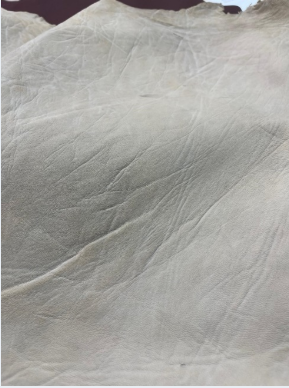
The first stage, the foundational tanning process, takes place in ground-set pits using Bagaruwa: the pods of Acacia nilotica, a botanical tannin source documented in West African leatherworking traditions and recorded by Freudenberg in his 1959 Hides and Skins Markets of the World — a privately published study obtained directly by Siegel Leather at publication. Bagaruwa forms part of a broader native-biologic tanning system that also includes traditional pigeon-dung bating, groundnut-oil lubrication, and sun-drying. No chromium. No synthetic shortcuts. The process is slow, and that slowness is the point: it allows tannin to penetrate gradually and evenly from grain through to the corium interior, rather than the rapid surface fixation characteristic of chrome tanning.
You can read more about this tanning tradition, and the historical documentation behind it, in our article Sokoto™ Goatskin: Tracing the Historical Roots of a Renowned Bookbinding Leather Tradition.
Stage 2: What Siegel Leather Adds
Traditional Nigerian crust leather and finished Sokoto™ archival leather are not the same material. This point is worth stating plainly, because some imitators stop at Stage 1 and claim equivalence. They do not understand — or do not care — that the archival performance of Sokoto™ is built in Stage 2. Copying the name without executing the process produces a different material entirely – a fake, a poor imitation of the original.
Following Stage 1 pit tanning, selected skins undergo a second controlled stage under Siegel Leather’s technical supervision in Western Europe. This is where the defining archival characteristics of Sokoto™ are established: vegetable retannage using appropriate tannin systems, pH stabilization, and sulfur-free finishing. All dyeing is performed at this stage. No coloration takes place in Nigeria.
The result is a material engineered for long-term stability — not surface appearance. We describe the full specification in our SOKOTO™ Conservation-Grade Goatskin Technical White Paper.
The Grain Is Not Decorative. It Is Structural.
The river grain of Sokoto™ is probably the most visually distinctive thing about it. It is also the feature most frequently faked.
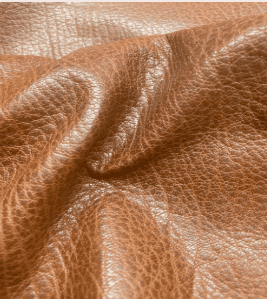
What makes it different is this: the grain on genuine Sokoto™ forms organically during pit tanning, as tannins interact with the fiber structure and the skin dries under natural conditions. It is not uniform. It is not repetitive. It is the result of a biological and chemical process, and it looks like one.
Embossed grain — which is what imitations use — is imposed mechanically after the fact. Under a loupe, the difference is visible: embossed grain shows a regular, tessellated pattern. Natural grain does not. But you don’t always need a loupe. Often the uniformity is apparent with the naked eye to anyone who has handled both.
The more important difference is structural. When you bend leather with a naturally formed grain, the grain and the corium beneath it move together. They were formed and tanned as a unified structure. When you bend embossed leather, the mechanical process that imposed the grain has already stressed the grain-corium interface. On lower-quality hides where this was done to disguise an inadequate natural surface, that interface is often already compromised before the binder touches it. The grain separates. And this is not a theoretical risk — we saw it in the sample we purchased from the competitor.
The USDA documented the consequences of exactly this failure mode in library bindings across American collections. Their 1930 Leaflet No. 69 — authored by chemists Frey and Veitch — remains one of the most thorough analyses of leather deterioration in institutional use. The relevant finding is straightforward: when the grain-corium interface is compromised, failure at the joints is not a question of if, only when. We discuss the USDA research in depth in our piece on premium bookbinding leather durability.
Full Grain Is Not a Marketing Term. It Is a Standard.
Sokoto™ is processed to the classical full-grain standard: hair removal only, with no sodium sulfide applied to the grain surface, no sanding, no buffing, no grain correction. The natural papillary layer is preserved intact. This is what allows the leather to receive gold tooling cleanly, to pare predictably, and to age without the surface failure that plagues mechanically altered hides.
We have written at length about the gap between the classical definition of full grain leather and what the term often means in commercial practice today. If you are sourcing leather described as full grain without asking specifically about buffing, embossing, or surface correction, you may be getting something quite different from what that phrase implies. See our article Full Grain Leather: Classical vs. EU Definition for the full picture.
Chrome in a Vegetable-Tanned Leather Is Not a Minor Issue
Testing of competing products marketed under similar names has confirmed the presence of chrome residues. This is not a technicality. It is a fundamental misrepresentation of the material.
Here is what chrome tanning is: a fast, industrially efficient process that fixes tannins into the hide in hours rather than weeks. It produces a soft, consistent, commercially reliable product. It is used widely across the leather industry for shoes, bags, and upholstery. But it is chemically incompatible with archival bookbinding — and any seller claiming to offer a Bagaruwa-tanned vegetable leather while delivering a chrome-tanned product either does not understand the chemistry or is counting on you not to notice.
The 1905 Royal Society of Arts Committee on Leather for Bookbinding was unequivocal on the subject of chemically treated and industrially processed leathers. Their findings, which remain the most authoritative scientific analysis of leather deterioration ever conducted, established the tannage chemistry as the primary determinant of long-term stability. We cover this history in our Leather Knowledge Series.
Our Sokoto™ production batches are tested to confirm non-detectable chromium content. That testing is part of the specification, and a guarantee of true quality.
How to Identify Genuine Sokoto™: A Practical Guide
Here is what to look for. These are not aesthetic preferences. They are structural and chemical facts.
| What to Look For | Genuine Sokoto™ | What Imitations Show |
| Grain pattern | Natural river grain — tight, irregular, formed organically during pit tanning | Uniform, repetitive pattern — a telltale sign of mechanical embossing |
| Grain–corium bond | Stays intact under bending; grain and corium move as one | Grain lifts or separates at flex points, particularly at joints and hinges |
| Tannage claim | Verified Bagaruwa (Acacia nilotica), correctly spelled, documented | “Begaruwa” or other misspellings — copied without understanding the chemistry |
| Chrome content | Non-detectable in tested batches | Chrome residues detected in tested competing products |
| Certificate of Authenticity | Numbered seal, batch traceable from pastoralist source to finished leather | None, or generic unverifiable labeling |
| Dyeing | All coloration done under Siegel Leather’s controlled Stage 2 retanning — none in Nigeria | Origin and dyeing process undisclosed |
The Certificate of Authenticity Is Not Ceremonial
Every Sokoto Traditional™ skin supplied by Siegel Leather carries a numbered Certificate of Authenticity with a formal seal. The authentication seal is a chain-of-custody documentation that enables institutional purchasers to trace the material to source.
The certificate documents breed and geographic origin (Nigerian Red Goat, northern Nigeria); the Stage 1 tanning agents and processes (Bagaruwa, pigeon-dung bating, groundnut-oil lubrication, sun-drying, ground-set pit tanning); and Stage 2 processing parameters under Siegel Leather’s specification. Batch-level pH and shrinkage temperature data are included.
No imitator has this. They cannot, because the documentation traces a process that is Siegel Leather’s — not a name they copied, but a two-stage system developed, specified, and verified over decades.
What the 1905 Committee Said About Imitation
The 1905 Royal Society of Arts committee on leather for bookbinding did not mince words about artificially grained and embossed leathers. Their recommendation, adopted by His Majesty’s Stationery Office, was explicit: the binder undertakes not to use leather embossed or grained artificially. This was not an aesthetic preference. It was grounded in documented evidence that mechanically altered grain fails — that the surface correction disguises structural weakness that manifests later, in the joints, under stress, across time.
We have had that finding sitting in our reference library for a long time. It did not surprise us when the sample we purchased from our imitator showed grain-corium separation on bending. The committee documented exactly that failure mode over a century ago. What is remarkable is that the people selling these imitations apparently have not read the literature. Or perhaps they have, and are relying on the assumption that their buyers have not. You can read the full report and our analysis in Leather for Libraries: Why It Still Matters Today.
A Note on Availability
We recently received a hand-delivered sample package from Sokoto for personal review of the latest production. The hides are outstanding. We maintain an excellent inventory of our core 16 colors — Black, Navy Blue, Red 104, Brown 205, Purple, British Tan, Grey, and others — all available in standard cut sizes, with a full shipment underway.
Every piece of Sokoto™ we sell carries a numbered seal of authenticity. That is your guarantee of what you are actually getting.
If you have questions about identifying genuine Sokoto™, or if you have encountered a product claiming similar characteristics and want a second opinion, contact us. We are happy to talk through specifics. This is the kind of conversation we have been having with bookbinders and conservators for a very long time.
Browse Sokoto™ Goatskin ? siegelleather.com/product/sokoto-goat/
Related Reading from the Siegel Leather Blog
- What Is Sokoto™ Leather from Siegel Leather?
- SOKOTO™ Conservation-Grade Goatskin: A Technical White Paper
- Sokoto™ Goatskin: The World’s Premier Archival Bookbinding Leather
- Sokoto™ Goatskin: Tracing the Historical Roots of a Renowned Bookbinding Leather Tradition
- Full Grain Leather: Classical vs. EU Definition
- Premium Bookbinding Leather: What History and Science Reveal About Long-Term Durability
- Leather Knowledge Series: Why Leather for Libraries Still Matters Today
About the Author — Steven Siegel is the owner of Siegel Leather and has served as an expert witness in leather-related cases for over two decades. His work is informed by historical research, archival analysis, and the scientific literature on leather deterioration, including the British Committee’s 1905 report and the USDA’s multi-decade research program.