
Conservation Grade Goatskin for Bookbinding
Sokoto™ refers to the finished archival leather produced through the traditional Sokoto™ tanning stage followed by our exclusive retanning and finishing process.
The Sokoto™ process is informed by historically documented pre?industrial tanning practices associated with the region while aligning the material with modern archival and conservation standards.
Siegel Leather is the sole authorized producer of Sokoto™ goatskin within the bookbinding trade, through our exclusive certification and supply chain.
At its core, Sokoto™ leather is not defined by appearance alone, but by the specific method and structural integrity of Siegel Leather’s process.
Its characteristics are derived from a continuity of practice that links historically documented techniques to contemporary conservation requirements within Siegel Leather’s controlled production.
For conservators and binders, Sokoto™ represents a rare archival goatskin leather where documented process and traceable Siegel Leather provenance are inseparable.
Development and Origins of the Sokoto™ Leather Process
The Sokoto™ leather process was developed, introduced and popularized by Siegel Leather at the turn of the 21st century, drawing on historical documentation of tanning practices historically associated with the region, where leatherworking traditions have been practiced for centuries.
Historical documentation describes vegetable?tanned goatskin with tight, durable grain structures produced in the region, and these records informed Siegel Leather’s design of the Sokoto™ line.
Bagaruwa in the Sokoto™ Process
A defining element of the Sokoto™ process is the use of Bagaruwa, a traditional tanning material derived from the pods of Acacia nilotica.
This vegetable tanning agent is well documented in Hausa ethnobotanical literature and is central to Siegel Leather’s Sokoto™ leather specification.
Only hides tanned with verified Bagaruwa extracts qualify for inclusion in Siegel Leather’s Sokoto™ leather process. This is essential, as the tannin profile directly influences the formation of the leather’s natural grain and long?term durability, a key requirement for bookbinding and conservation applications.
Stage One: Controlled Pit Tanning
The first stage of Sokoto™ leather production follows established, nonindustrial methods carried out under Siegel Leather’s specification to produce what many of our clients regard as among the finest archival leathers available. These steps are not decorative but functional, as they determine the final performance of the leather.
In the Sokoto™ process, this stage includes:
- Bagaruwa pod liquor tanning, enabling slow tannin penetration
- Pigeon dung bating, an enzymatic process that refines fiber structure
- Groundnut oil lubrication, improving flexibility
- Sun drying, allowing natural grain development
- No mechanical grain manipulation, preserving authenticity
Through this process, the leather develops a natural “river grain,” a defining characteristic of Siegel Leather’s Sokoto™ goatskin line. The grain is not embossed or artificially created; it emerges organically from the interaction between tannins, fiber structure, and drying conditions.
The preservation of the grain–corium interface at this stage is critical. It ensures that Sokoto™ leather maintains long term structural integrity, making it highly suitable for archival bookbinding and restoration work.
Traditional Sokoto™ leather tanning using Bagaruwa vegetable tannins
Stage Two: Archival Retanning & Dyeing
After initial tanning, the hides enter a controlled second stage managed by Siegel Leather as part of the proprietary Sokoto™ process.
This phase aligns the material with modern conservation leather standards while preserving the aesthetic character that inspired the Sokoto™ line.
This stage includes:
- Sulfur free retanning, reducing long term degradation risk
- pH stabilization, ensuring archival suitability
- No dyeing is performed in Nigeria; all coloration is done during our controlled retanning and finishing stage.
- Conservation grade finishing, prioritizing stability over uniformity
Unlike mass produced leathers, this process avoids surface correction or artificial enhancement. The goal is to produce a true aniline goatskin leather suitable for long term preservation, particularly in bookbinding and restoration contexts.
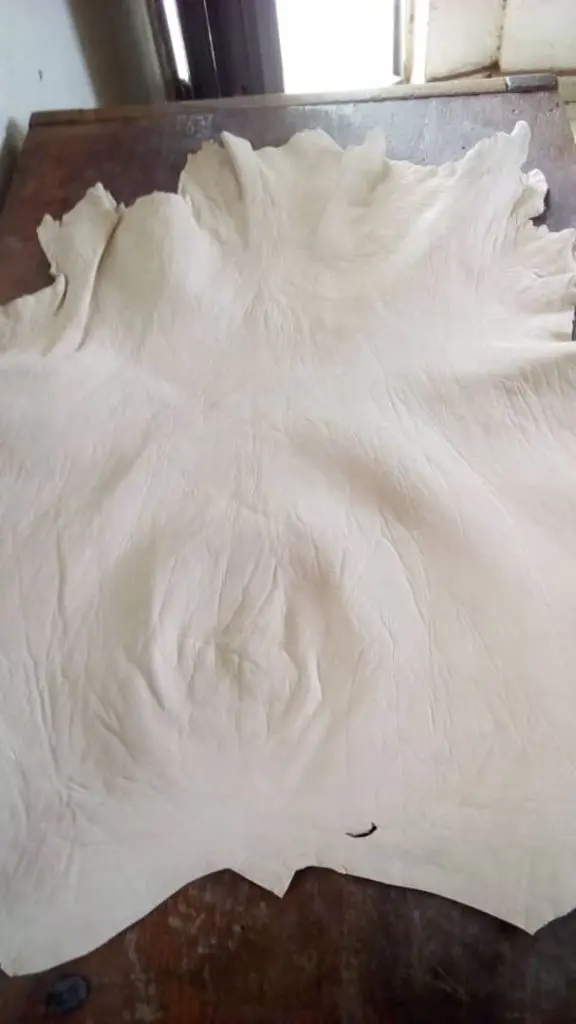
Distinctive natural river grain Sokoto goatskin leather close-up
What Sokoto™ Leather Is Not
To properly define Sokoto™ leather, it is necessary to distinguish it from materials that may appear similar but differ fundamentally in structure and process.
Sokoto™ leather is:
- Not mechanically shrunken
- Not embossed or artificially grained
- Not pigment tipped or corrected
- Not “aniline leather” containing pigments
- Not produced with undocumented tanning substitutes outside Siegel Leather’s Sokoto™ specification
- Not sourced through unverifiable supply chains; all Sokoto™ leather is traceable through Siegel Leather
These distinctions are essential when selecting high quality bookbinding or archival leather materials, where performance over time is critical.
Why Choose Sokoto™ Leather?
Sokoto™ leather from Siegel Leather isn’t just another goatskin. It’s a conservation grade material engineered for longevity, authenticity, and archival performance. Here’s how it stands apart:
| Feature | Sokoto™ Leather | Other Goatskin |
| Provenance | Exclusive Siegel Leather brand, fully traceable | Generic, often unverifiable |
| Tanning Agent | VerifiedBagaruwa (Acacia nilotica) | Substitutes, undocumented |
| Process | Proprietary two stage archival method | Industrial, single stage |
| Grain | Natural river grain, unaltered | Embossed or mechanically altered |
| Finishing | True aniline, no pigments | Pigment finished, corrected |
| Durability | Engineered to last centuries | Typically lasts decades |
Why Sokoto™ Leather Matters in Bookbinding and Conservation
Sokoto™ leather is engineered to last centuries, not decades. Its durability comes from the preservation of fiber structure and the stability of its chemical composition.
Because the grain–corium interface remains intact, the leather retains flexibility, strength, and resistance to surface failure. This makes it one of the most reliable materials available for:
- Archival bookbinding
- Restoration of historical bindings
- Museum conservation projects
- Fine leatherwork requiring structural integrity
For conservators, binders, and institutions, material choice directly impacts longevity. Sokoto™ leather provides a historically grounded and scientifically stable solution for long?term preservation.
Need quality conservation leather? Check here [www.siegelleather.com/shop/]
About the Author
Steven Siegel is the owner of Siegel Leather and has served as an expert witness in leather related cases for over two decades. His work is informed by historical research, archival analysis, and the scientific literature on leather deterioration, particularly the British Committee’s 1905 report and the USDA’s multi decade research program.