
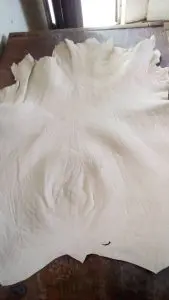
Anyone who has worked seriously with bookbinding leather for any length of time runs into the same set of questions eventually. Where did this hide come from? Is that grain real? How was it tanned—and did anyone along the way do something to the surface to make it look better than it actually is? These aren’t pedantic questions. They are the questions that separate a binding that will survive a century from one that starts to fail in a decade.
What’s striking is how thoroughly these questions have already been answered, and not just by modern marketing claims, but by rigorous historical inquiry. The official report by the Royal Society of Arts committee on bookbinding leather published in 1905 in London, and subsequently the U.S. Department of Agriculture through decades of laboratory research, produced findings that remain the most authoritative scientific analysis of leather deterioration ever conducted. Their conclusions still guide conservators, institutional librarians, and serious binders today. We’ve written in depth about the 1905 report in our Leather Knowledge Series. If you haven’t read the first thirty pages of Leather for Libraries, we genuinely encourage you to.
Natural Grain vs. Mechanically Altered Grain
The 1905 committee drew a very clear line between leather with a naturally formed grain and leather whose grain has been mechanically imposed or corrected after the fact. This distinction matters more than almost any other single factor in predicting long-term performance.
The grain layer and the corium beneath it are bonded together in naturally formed leather. When you plate, emboss, stretch, buff, or otherwise apply a “corrective” process to a skin, you are stressing that bond. Mechanical alteration does not only change the surface appearance but it also weakens the structural relationship between the two layers that were meant to move and age together. Once that relationship is compromised, surface failure is not a question of if, only when.
“Mechanically graining leather disrupts the delicate bond between the grain layer and the corium, leading to double hiding, weak breaks, and premature separation of the leather layers. For serious bookbinding leather suppliers, maintaining the natural integrity of this interface is non-negotiable.”
— Siegel Leather, Leather Knowledge Series
What the USDA Studies Actually Found
The USDA contributed its own body of evidence through laboratory analysis of deteriorated bindings held in American libraries. In their 1930 Leaflet No. 69, USDA chemists Frey and Veitch documented bindings in various stages of decay, attributing deterioration primarily to tannage chemistry and the residual acids introduced during manufacture. Their findings reinforced what the 1905 British committee had established: that the choice of tanning materials and finishing processes determines long-term stability, and that no amount of subsequent treatment can fully reverse a flawed foundation.
This work is not antiquated. The chemistry of collagen degradation has been confirmed and expanded by modern spectroscopic analysis. In one instance, researchers at ACS Omega used ATR-FTIR imaging to visualize the degradation mechanisms the USDA described, including collagen gelatinization in historical bindings. While the science has gotten sharper, the conclusions have not changed.
Key USDA publications for further reading:
- Preservation of Leather Bookbindings. Frey, R.W. & Veitch, F.P. USDA Leaflet No. 69. Washington, D.C.: U.S. Dept. of Agriculture, 1930.
- Leather Bookbindings: How to Preserve Them. Rogers, J.S. et al. USDA Leaflet No. 398. Washington, D.C.: U.S. Dept. of Agriculture, 1956.
Both the 1905 British committee and the subsequent USDA research identify sulfur compounds introduced during tanning, dyeing, or finishing as a known long-term deterioration risk. It is a finding that informs how we approach chemistry at Siegel to this day.
Why Most Commercial Goatskins Fall Short
The modern leather industry is largely organized around high-volume, low-cost production. Commercial goatskins dominate global supply chains, and there is nothing inherently wrong with that for most applications. But for archival bookbinding, the picture is more complicated.
Historically, these goatskins generically referred to as Persians (though most likely from India, per the literature) were not considered appropriate for durable bookbinding leathers, and the 1905 committee noted their frequent subjection to grain manipulation. That situation has not improved. The economics of modern production also push in the other direction: when a skin has an irregular or insufficiently tight natural grain, embossing, plating, or boarding can make it look like something it is not and cheap. The visual result can be convincing, but the structural consequences are still the same ones documented over a century ago.
For a broader overview of how different leather types perform in bookbinding contexts, the American Institute for Conservation’s wiki on leather bookbinding is a useful independent resource.
How Siegel Sources Differently
Historically proven regions, naturally formed grain
We source goatskins from regions with centuries-old traditions of producing naturally tight, durable grain. And this matters. It is about matching the grain structures found in surviving historical bindings to establish an empirical baseline, one that modern marketing language simply cannot provide. Our goatskins come from several different countries and regions, depending upon the required grain pattern to be historically correct. We do not purchase from a single area trying to emulate non indigenous grain patterns
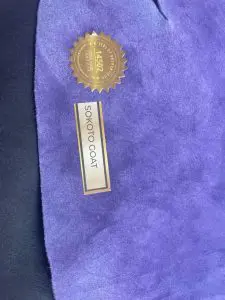
Finished Siegel Leather goatskin.
Regions such as West Africa, particularly Sokoto™, renowned for its pot-tanned skins prized for remarkable strength and distinctive natural grain, consistently meet this standard. They are the actual source region whose skins match what conservators encounter when they examine bindings that have held together for four hundred years.
Minimal pigment, maximum authenticity
We select only top-grade skins where the natural grain has no /minimal flaws, such that it does not need to be disguised. What you see on the surface is the actual grain of the animal. The result is leather that varies slightly from hide to hide, just as historical bookbinding leathers always have. That variation is not a defect. It is evidence of authenticity.
Sulfur-controlled chemistry
Our NTND goatskin and SF calf are produced using sulfur-controlled formulations verified through laboratory analysis. The significance of this is easy to understate: even leather marketed as “vegetable-tanned,” “archival,” or “conservation grade” is frequently not tested for sulfur content. The label describes an intent, not a verified chemistry. Our testing confirms what is actually in the leather.
This level of chemical accountability is rare in the contemporary market, although it was standard practice in the finest tanneries of the nineteenth century. So, we have not invented a new standard, we have simply maintained one that most of the industry has allowed to lapse.
Our Available Leathers
Every leather we offer has been developed in response to the specific needs of binders and conservators, not fashion or upholstery markets. Each skin reflects the sourcing and chemical standards described above. Below is a partial listing—contact us for the full range or for guidance on which leather suits a specific project.
- SF Calf
- UK Calf
- Natural Sheepskin
- Natural Goat
- 0.5 mm Veg Goat
- Smooth Historical Goat
- Capra Granulosa
- Sokoto™ Morocco
- Sokoto™ Traditional
- Genuine Levant
Further Reading
For those who want to go deeper, the following external resources are worth your time:
- AIC Book & Paper Group — Use of Leather in Book Conservation: a thorough practitioner-oriented wiki entry covering tanning, grain types, historical use, and modern conservation practice.
- ACS Omega — Degradation and Conservation of Historical Leather Book Covers: peer-reviewed spectroscopic analysis confirming collagen degradation mechanisms in historical bindings.
- AIC/FAIC — Conservation of Leather Bookbindings Workshop: a professional development course covering current conservation techniques, delivered by Jeffrey Peachey.
- Official report by the Royal Society of Arts committee on bookbinding leather
© Siegel Leather · Leather Knowledge Series · Questions? Contact us