What Our Leather Knowledge Quiz Revealed
By Steve Siegel, Siegel Leather
This fall we sent our customers a short quiz. We had received a cowhide sample from a supplier who wanted to know whether we might make something similar, because the leather is apparently popular for certain kinds of bookbinding. It was advertised as Italian-made, about 5 oz in substance, and full grain.
The surface looked wrong to us. Instead of ruling on it alone, we put photographs in front of our customers and asked one question: full grain or corrected grain?
The answers were split, and the split taught us something. This article explains what the two terms mean, how to tell them apart, why the difference matters to anyone who binds, restores or buys leather, and what to ask before you pay for something sold as full grain.
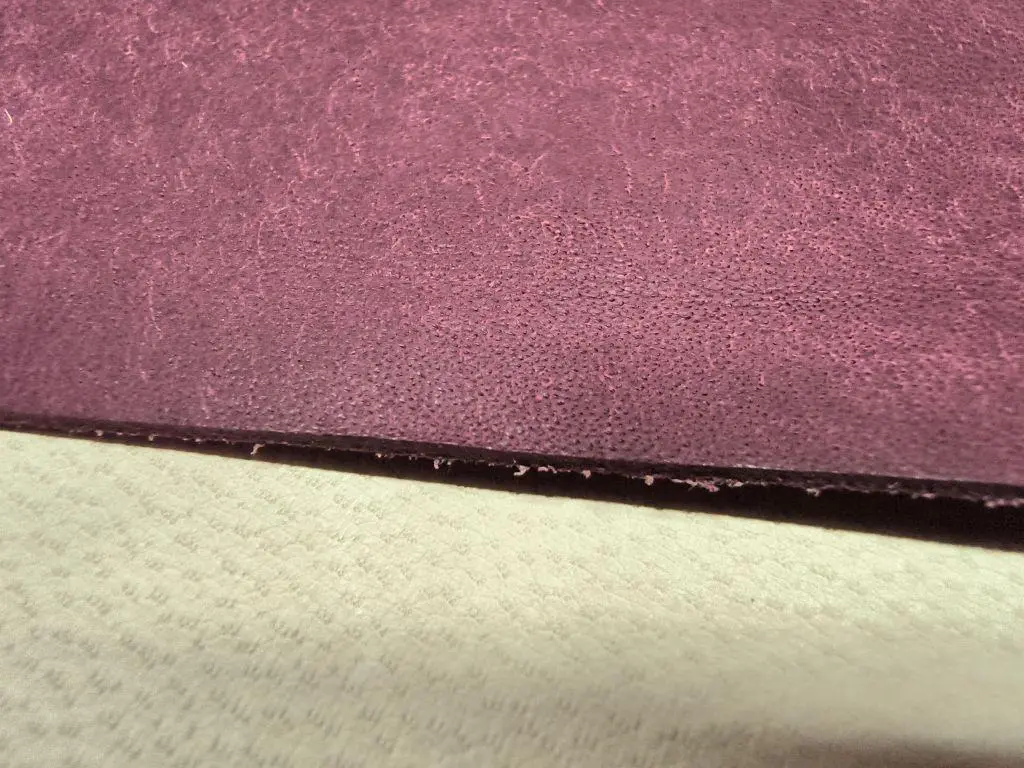
The cowhide sample we asked our customers to judge.
What our customers told us
Most respondents said the leather was not full grain. They described it as corrected grain and pointed to the sanded look of the surface, the visible white lines, and grain tips that appeared to have been removed. A smaller group called it full grain or said they were unsure, usually because the pore structure still showed in places.
A few of the replies:
- “The leather is definitely corrected. You can see that tips of the grain are removed in the pictures.”
- “Since the leather surface was sanded it is no longer full grain. I think it would be considered corrected grain.”
- “As far as the grain it would appear to be full grain. Mainly because you can see the pore structure and the grain.”
Both sides were looking at the same photographs, and both had a point. When correction is light, pores and grain pattern can survive, or be recreated, on a surface that has been abraded. That is exactly why the question is worth answering carefully.
What “full grain” means
Full grain leather keeps its original grain surface. The hair and epidermis are removed, and nothing else. No sanding, no buffing, no snuffing, no splitting away of the grain. The natural pores, growth marks and surface texture of the hide are all still there, because the hide’s own surface has not been touched.
This is the classical definition, and it is the one bookbinders have always used. It is also, on the point that matters here, the legal and standards definition. The EU footwear labelling directive (94/11/EC) says “full grain” applies to leather with the original grain surface and none of that surface removed by buffing, snuffing or splitting. The ISO leather terminology standards take the same position. In the United States, Customs practice follows the same definitions, and a ruling on a buffed and embossed leather treated it as no longer full grain because the original surface had been buffed away.
So on sanding there is no disagreement between the classical and the regulatory definitions. Where they part company is on heavy finishing and embossing, which we covered in Full Grain Leather: Classical vs. EU Definition. A leather that has been sanded fails both tests.
What “corrected grain” means
Corrected grain leather has had its grain surface sanded, buffed or abraded, partly or completely, to remove or hide natural marks such as scars, insect damage, brand marks and wrinkles. A pigmented finish is then applied over the corrected surface. Often an artificial grain pattern is pressed in as well, so the leather looks as if it has a natural grain again.
This is a legitimate process with a long history, and corrected leather is common in upholstery, footwear and many consumer goods. Tanneries use it to turn hides with a lot of surface damage into a uniform, usable material. Nothing about the process is secret or shameful.
The problem starts only when corrected leather is described as full grain.
The terms side by side
| Term | Grain surface | Typical surface | Notes |
| Full grain | Original, intact | Natural pores, growth marks and imperfections visible | No buffing, sanding or snuffing |
| Corrected grain | Partly or fully removed by sanding or buffing | Uniform, usually pigmented, often embossed with an artificial grain | Used to hide defects |
| Top grain | Varies by seller | Varies | Used inconsistently. Some sources treat it as identical to full grain, others as a gentler name for corrected grain. |
| Split | Grain layer is not present | Suede-like or coated | Cut from the lower layers of the hide |
How to tell the difference
There is no single test you can run by eye, but there are several signs that point in the same direction. The more of them you see together, the stronger the evidence.
Flattened or missing grain tips. On an intact grain surface, the fine peaks of the grain stand up. Sanding shaves them level. Under magnification or raking light, a corrected surface looks planed rather than textured.
White or pale scuff lines. Abrasion leaves fine light-coloured lines, especially where the surface catches the light, much like scratches on a polished tabletop. These were the lines most of our respondents spotted in the sample.
An unnaturally even pattern. Natural grain varies from one area of a hide to another. If the pore pattern repeats, looks uniform across a large area, or seems pressed in rather than grown, an embossed pattern is a likely cause.
A coating you can see at the edge. Look at the cut edge. A distinct pigment or finish layer sitting on top of the leather suggests a coated, corrected surface rather than a dyed-through natural one.
A surface that hides everything. Real full grain shows its history. Healed scratches, vein marks and variation in the grain are normal. A surface with no character at all, on a hide that has seen a pasture, deserves a question.
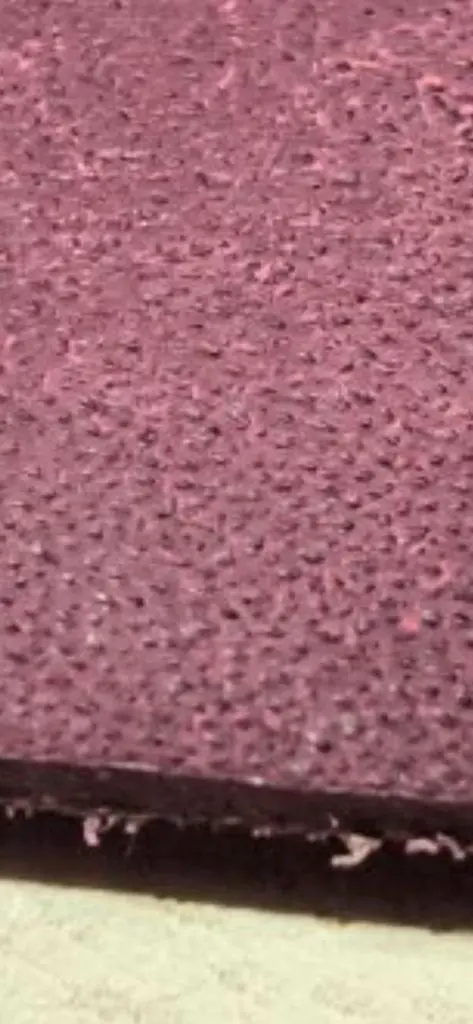
Close-up of the sample. The pale lines and flattened grain are consistent with sanding or sandblasting.
The limits of looking
Our quiz proved something worth admitting: experienced leatherworkers can read the same photograph differently. Light correction is hard to judge by eye, and photographs make it harder.
There is a more reliable method, but it belongs in a laboratory. Researchers in the leather chemistry community have described a procedure that removes the finish from the surface and then examines the exposed grain, because without removing the finish there is no dependable way to confirm whether buffing had occurred. If a purchase is large, or the claim matters, ask the seller whether such testing has been done.
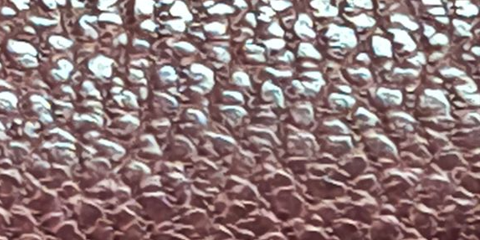
Intact grain on the right, abraded surface on the left.
Our assessment of the sample
Based on the photographs, the sample shows clear signs of surface abrasion. The white lines and flattened grain tips are consistent with sanding or sandblasting. We know the look well, because years ago we used sandblasting on goatskin ourselves to cover defects and create a particular effect. It produced an interesting surface, but it removed the natural grain layer, and we would not have called the result full grain.
In our judgment, the sample is corrected grain. We reached that from photographs and our own experience, not from laboratory testing, and we say so plainly.
This is not a verdict on whether the leather is good. Corrected grain can perform well and suits some work. The issue is the description. WHEN LEATHER IS OFFERED AS FULL GRAIN, THE GRAIN SURFACE SHOULD BE INTACT.
Why it matters for bookbinders
The grain surface is the outermost layer of the hide, and removing it changes how the leather behaves. We would put it this way for people who bind or restore:
- How it ages. An intact vegetable-tanned grain surface takes on character over decades. A pigmented, corrected surface sits under a coating, so it ages differently, and the coating can crack or wear instead of burnishing.
- How it works. Tooling, blind and gold, depends on how the surface takes pressure, moisture and heat. Paring and shaping respond to what is under the surface. A coated or embossed grain behaves differently from a natural one.
- How honestly you can represent the work. If you tell a client the binding is full grain leather, you are making a promise about the material.
- Archival standards. Leather sold as archival should have no grain manipulation at all: no embossing, no pressing and no boarding. A corrected surface cannot meet that standard.
There is still a place for embossed and corrected leathers. Our River Grain article explains where that is: practice work, non-archival projects, and students learning to cut, pare and cover. Used for what it is, it serves those jobs well. Sold as something else, it does not.
Why accurate labelling matters
Most people who repeat a wrong label did not invent it. A supplier says “full grain,” the next seller passes it on, and a buyer ends up paying a premium for something that is not what the label says. We cannot know what any seller knew, and this article does not accuse anyone.
But we hold a firm view, and we hold ourselves to it. If you sell leather as full grain, you are responsible for checking it. If you cannot check it, you say so. A buyer is trusting you for knowledge they do not have, and that trust is the whole transaction.
I have served as an expert witness on leather identification and quality matters, and I can tell you the distinction is not semantic. A mislabelled material creates commercial exposure, and in some situations legal exposure, for the seller. Clear terms protect the person who sells and the person who buys.
We have tried to apply the same rule to our own leather. The leathers we sell as full grain are checked against the classical definition before they go on the shelf, and we say plainly when something is not.
A buyer’s checklist
Before you buy leather sold as full grain, ask:
- Has the grain surface been sanded, buffed or snuffed at any stage?
- Has an artificial grain been embossed or pressed into the surface?
- Is there a pigment or surface coating, and how thick is it?
- Which definition of “full grain” does the seller use, classical or regulatory?
- What does the seller mean by “top grain”?
- Can the seller provide a close photograph of the grain and the cut edge, in natural light?
- Has the leather been tested, and by whom?
- Where was the hide sourced, and how was it tanned?
A seller who knows the answers will give them readily. A seller who hesitates has told you something too.
Frequently asked questions
Is corrected grain real leather? Yes. It is real leather whose grain surface has been sanded or buffed and then finished, often with an embossed pattern. It is not full grain.
Is top grain the same as full grain? Not reliably. The term is used inconsistently. Some sources treat it as identical to full grain and others as a softer name for corrected grain. Ask the seller to define it.
Can you tell full grain from corrected grain by looking? Often, but not always. Flattened grain tips, pale abrasion lines and an unnaturally uniform pattern are strong signs. Light correction can fool experienced people, and only laboratory testing is conclusive.
Is corrected grain bad leather? No. It suits some uses well. What matters is that it is described accurately, and that it is not used where an intact grain surface is required, such as archival work.
Why does full grain matter for bookbinding? Because the original grain surface affects how the leather ages, tools, pares and finishes, and whether it can honestly be offered as archival.
Questions about a leather you are considering
If you have a sample you are unsure about, or want to know how any of our leathers meet the classical full grain definition, write to us directly. Steve answers personally. You can also browse our bookbinding leathers or read our Reference page for the full comparison.