
Siegel’s Sokoto™ Traditional (23 Colors): The Definitive Authority
Siegel Sokoto Traditional – Provenance, Heritage, and Origin
Siegel’s Sokoto™ Traditional is the world’s most rigorously authenticated archival bookbinding goatskin. Produced using documented historical methods and verified modern conservation standards, it represents the highest expression of true Sokoto™ leather available today.
The name Sokoto is a historical benchmark, denoting the finest West African goatskin sourced exclusively from the arid, northern region of Nigeria. Critically, while the region has long produced hides, the designation of “Sokoto leather” as a modern commercial term for bookbinding leather was largely introduced and popularized by Siegel Leather in the late 20th century.
Earlier binding authorities, like Bernard Middleton and Douglas Cockerell, did not use “Sokoto” as a leather designation. Instead, their works referred to them as “Niger” or “Nigerian goatskin” (or sometimes “Niger Morocco”) and this describes the high-quality, distinctive-grained leather they used. Siegel adopted the term “Sokoto goatskin” to definitively distinguish skins that were distinctively-grained, hand-tanned, resembling the best historic “Niger Morocco”, and retanned with forethought to maintain historical value.
Siegel Leather is the sole authorized producer of Sokoto™ Goatskin. Any material sold outside our certification system does not meet the Sokoto™ standard.
The Traditional Two-Stage Process
Stage 1: Traditional Pit Tanning in Sokoto, Nigeria
- Tanned exclusively with Bagaruwa (African Acacia pods)
- Processed in ground-set pits, not drums
- Bated with pigeon dung, a historical enzymatic method that opens the fiber structure
- Fat liquored with ground nut oil
- Only native botanicals, and, of course, no petrochemicals
- No chrome, sulfur, or industrial chemicals
- Produces the naturally occurring river-grain pattern that cannot be embossed or mechanically replicated
Stage 2: Expert Retanning & Coloring
- Conducted under Siegel’s technical supervision
- Uses only vegetable tannins and aniline dyes
- No chrome, azo dyes, metal-complex dyes, or pigments
- Leather where the distinctive grain is created by mechanical means is not authentic
- Ensures chemical stability while preserving historical integrity
Result: A leather that remains stable, flexible, and structurally sound for centuries, not decades.
There is no dyeing performed in Nigeria for this product. At this stage, the leather remains undyed and not fully fleshed, yet it is already sulfur-free and archival in nature, as established by historical use and conservation standards.
To prepare the skins for the specific demands of fine bookbinding, the leather is subsequently retanned and then dyed under our direct technical supervision. In this second stage, Siegel Leather strictly adheres to the traditional formulas, using only appropriate vegetable tanning compounds and archival-safe colorants. We never employ chrome, azo dyes, or metal-complexed dyes, as their use would compromise the historic integrity and permanence of the leather.
This two-stage process, authentic preparation in Sokoto followed by careful retanning and coloring using traditional, natural botanicals, ensures that every Sokoto™ skin retains its historical character while meeting the exacting standards of modern conservation and fine binding.
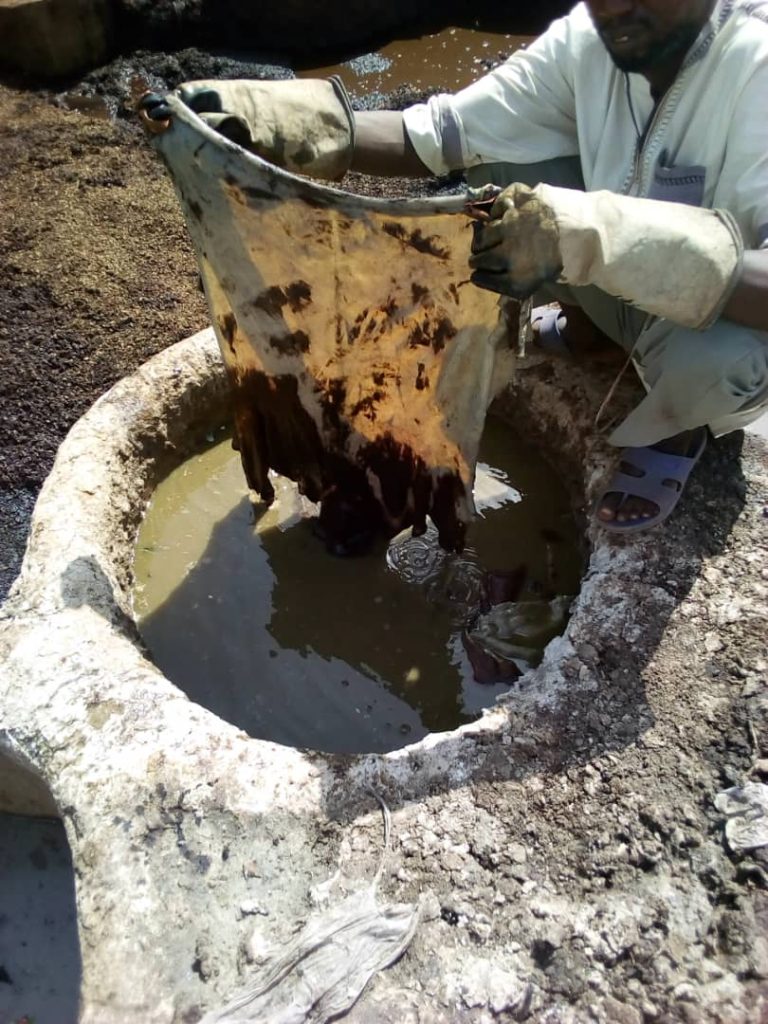
Visual documentation of the traditional tanning process used to create Sokoto Red Goat leather artifacts.
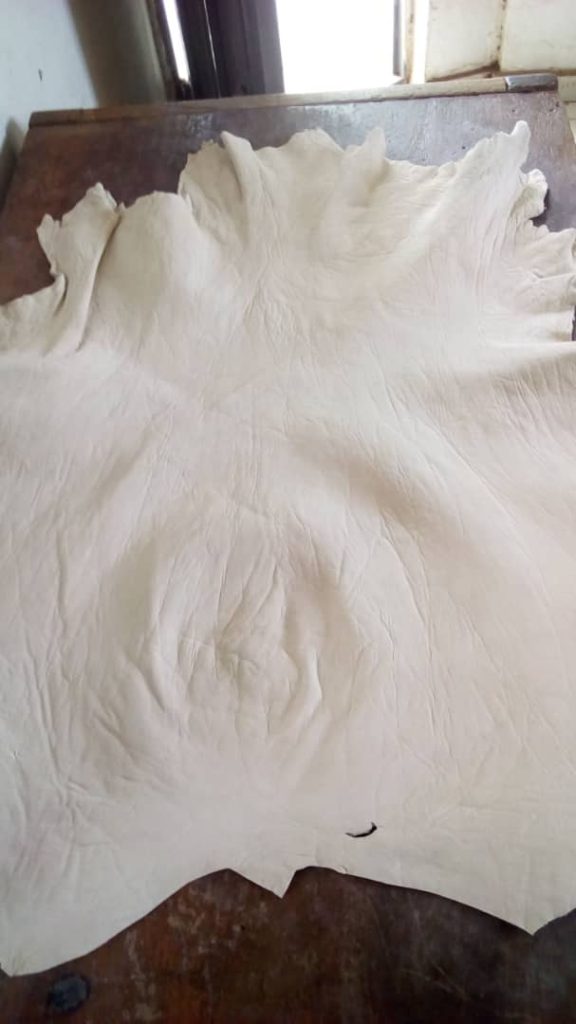
Close-up of a finished, light-colored leather hide showing the natural grain pattern and texture.
Siegel’s Authority and Integrity
The Siegel Sokoto™ Traditional Goatskin, prepared with the same thorough natural processing as of old, holds the same historical value and deep institutional heritage that modern reproductions fail to achieve.
- The 1905 Report of the Committee on Leather for Bookbinding by the Royal Society of Arts, London affirmed Sokoto goatskin as the premier vegetable-tanned goat leather, due to its unique structure and inherent strength.
- Siegel Leather’s definition of Genuine Sokoto™ Goatskin encompasses geographic origin and an uncompromised tanning recipe. This integrity stands in contrast to non-certified materials, which frequently replicate terminology without adhering to the documented process and technical standards that define genuine Sokoto™, even misspelling core ingredients like “begaruwa,” a chemical that does not exist.
Historical Origins & Cultural Provenance of Sokoto™ Leather
The Sokoto Red Goat is born and raised by Fulani pastoralists in northern Nigeria, where climate, terrain, and free-range husbandry contribute directly to the strength, density, and longevity of the skins. These environmental and cultural factors have shaped the character of Sokoto leather for centuries.
During the era of Trans-Saharan trade, skins originating from the town of Sokoto were highly sought after in Europe for fine bookbinding. Transported through North Africa, these leathers became known in the West as “Moroccan” or “Cordovan” leather, prized for their durability, distinctive grain, and exceptional beauty.
The historic value of Sokoto leather lies not only in the animal itself, but in the traditional methods of preparation. Skins are carefully selected by experienced craftsmen, with techniques passed down through generations. The early stages of preparation are performed without industrial chemicals, including during shaving to thickness, which is carried out manually to preserve the integrity of the hide.
Tanning is conducted slowly in ground-set pits using Bagaruwa (Acacia Nilotica) and other natural botanical extracts, with bating performed using traditional organic agents. This deliberate, low-agitation process allows for full penetration of tannins and develops the leather’s characteristic firmness, water resistance, and long-term stability against heat, light, and atmospheric pollutants.
These methods give rise to the distinctive natural “river-grain” pattern for which genuine Sokoto leather is known, a grain structure that cannot be reliably reproduced through mechanical or industrial processes. The combination of animal origin, environment, and traditional pit tanning results in a material uniquely suited for archival bookbinding.
After decades of declining availability, Siegel Leather undertook extensive research into the history, chemistry, and traditional preparation of Sokoto leather and was the first in the modern era to reintroduce this material to the bookbinding and conservation market in a verifiably archival form. Today, Sokoto™ continues to be valued by professional binders not only for its exceptional durability, but for its unmatched workability, aesthetic depth, and historical authenticity.
The Authentic Recipe
The unique qualities of Siegel’s Sokoto™ Traditional leather stem from an all-natural vegetable tanning process. Our knowledge of the Bagaruwa archival tanning chemistry guarantees that we achieve a grain quality like no other. Unlike modern leathers, our Sokoto skins are tanned in traditional pots using all-natural botanicals:
Bagaruwa Tannage The initial process uses Bagaruwa (African Acacia Pods). This 100% vegetable tannage, documented by Freudenberg (1959), is crucial for developing the skin’s unique characteristics and ensuring the necessary fiber alignment.
- The Bagaruwa Process: This natural tannage is conducted in traditional methods under the direction of our technical consultant, Chemist LLC. The tannins penetrate the hide slowly and deeply, and the concentration of tannins in Acacia Nilotica is ideally suited to condition the skin for the second tanning stage while facilitating the natural development of the famous “river” grain appearance.

Visual documentation of the traditional tanning process used to create Sokoto Red Goat leather artifacts — photo taken by our staff.
Siegel’s Authenticity and Provenance
We recognize that 20th-century industrial changes can compromise traditional formulas. But at Siegel Leather, we have invested in lab testing and technical consulting to ensure our tanning process is corrected and verified to match the pre-1900 Bagaruwa standard. And on top of that, each skin has its “authenticity label”, which is a stamp of approval of its quality and provenance.
Our raw stock is ethically and sustainably acquired through local cooperatives in Sokoto, pre-tanned, and then carefully shipped to specialized tanneries in the EU for the final coloring and over-tanning with the same historic formulas that gave the Sokoto™ its fame. This complex, multi-stage supply chain demonstrates an uncompromised commitment to verified provenance and continuous access.
For the conservation and archival community, permanence is non-negotiable and Siegel Leather provides only the best quality archival leather that guarantees longevity of your restoration and archival bookbinding work. At Siegel Leather, every claim we make is supported by process documentation, laboratory verification, and traceable origin. Our leathers are verified and are the very best Aniline, vegetable-tanned goatskin in the frame of the revered Niger Moroccos. The Siegel Sokoto™Traditional (23 Colors) is the absolute hallmark of today’s archival bookbinding leathers and it can only be obtained from Siegel Leather.
Siegel Leather is the sole owner and authorized producer of Sokoto™ Goatskin. Any material sold outside our certification system is not produced under the Sokoto™ standard.
Laboratory Verified Authenticity
Periodic independent laboratory testing confirms:
- Zero detectable chromium (Cr III and Cr VI)
- Sulfur-free vegetable tannage as Stage 1, laboratory tested
Testing has identified chrome residues in competing products marketed as “Sokoto”, evidence of modern shortcuts that disqualify them from true archival classification..
Our Uncompromising Rejection of Chrome.
The presence of chrome is an unarguable evidence that underscores the fundamental difference between us and materials not produced under the Sokoto™ certification system:
- Shoe Leather vs. Bookbinding Leather: Companies accustomed to producing shoe leather (routinely tanned with chrome) fail to grasp a fundamental truth: leather intended for bookbinding cannot be considered historic or archival if it has been processed with chrome or similar substances. Shoe leather may suffice for covering the sole of a foot, but it bears no relation to the standards required of true bookbinding leather, which is crafted to preserve, protect, and remain steady for a lifetime.
Classical Full Grain – No Compromises
Sokoto™ Traditional adheres to the strictest classical definition of full grain:
- Hair removed only — no buffing, sanding, or grain correction
- Zero pigment surface (true full aniline finish)
- Preserves the critical grain–corium interface
- Exceptional receptivity to:
- Gold tooling
- Blind tooling
- Traditional gold leaf/albumen gilding
This is the reason Sokoto™ Traditional resists powdering, cracking, and surface failure common in imitation “Sokoto” leathers.
Technical Proof
Some modern manufacturing techniques attempt to replicate the distinctive “rivers” or lines of genuine Sokoto. This manipulation results in a bad break and loose grain, as the process weakens the critical grain–corium interface, and undermines the integrity of the material.
- Our Grain Corium: Our natural grain, which is a direct result of the Bagaruwa/Sumac tannage, preserves this interface for maximum durability.
- True Aniline: We have a Zero-Pigment Rule. Our finish utilizes True Aniline dyes. This Zero-Pigment Rule ensures the full, rich color permeates the leather while highlighting the natural grain pattern.
Traceability and Assurance: The Sokoto™ Certificate of Authenticity
The final layer of authority is dedicated to verifiable traceability. This system is designed to meet the strictest standards of museums and conservation centers worldwide, confirming every skin’s provenance, processing, and archival suitability.
The Certificate of Authenticity (COA) Standard – Every Genuine Sokoto™ Goatskin from Siegel is assigned a unique, individually traceable number. This number corresponds to a specific Certificate of Authenticity (COA), which documents:
- Production Batch and Origin: The precise date, lot, and verified source in the Sokoto cooperative, backed by legal affidavits of origin.
- Material Integrity: Confirmation of the final product and Sulfur-Free archival status (as confirmed by lab testing).
- Affidavit on Grain Integrity: The COA confirms that the skin adheres to the Classical Full Grain Standard and was processed without mechanical manipulation, thus preserving the crucial grain-corium interface.
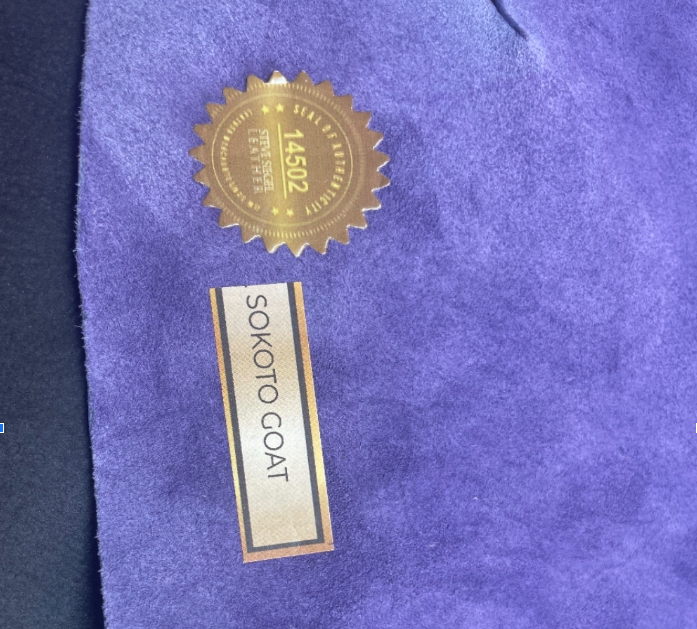
Official Seal and Unique Traceable Number for Genuine Sokoto™ Goatskin.
This verifiable paper trail, backed by scientific and legal assurance, transforms the material from a commodity into an archival asset. If it’s not from Siegel, it’s not Sokoto™.
| Feature | Function | Competitive Advantage |
| Unique Skin Number | Ensures every skin is individually tracked. | Prevents bulk substitution of inferior stock. |
| Lab Tested | Guarantees compliance with archival standards. | Demonstrates compliance with archival standards not met by chrome-tanned or pigmented leathers. |
| Affidavit of Origin | Legal backing for source material from Sokoto, Nigeria. | Disproves competitor claims of exclusive access or control over the supply chain. |
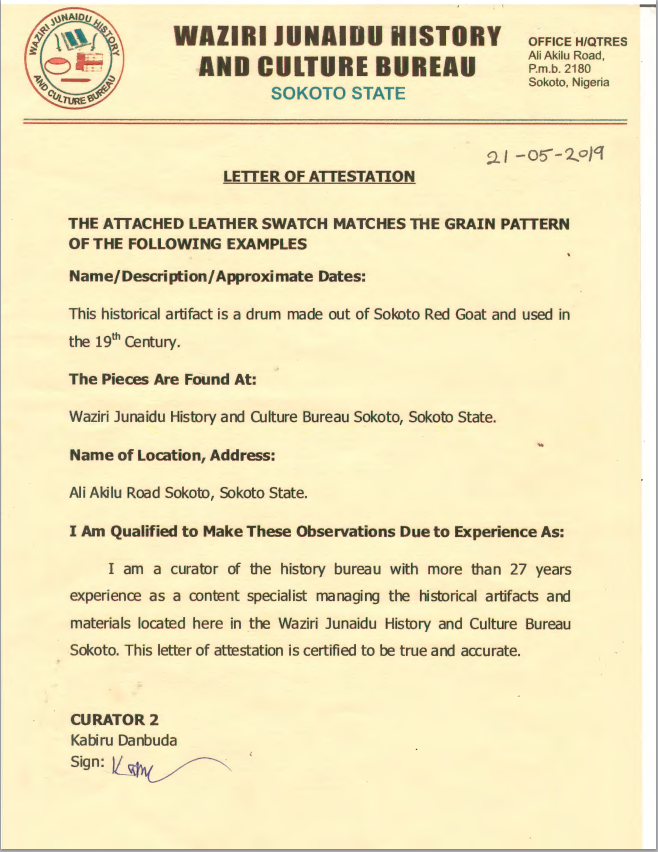
Official attestation by Curator Kabiru Danbuda certifying that a leather swatch matches the grain pattern of a 19th-century drum made from Sokoto Red Goat skin.
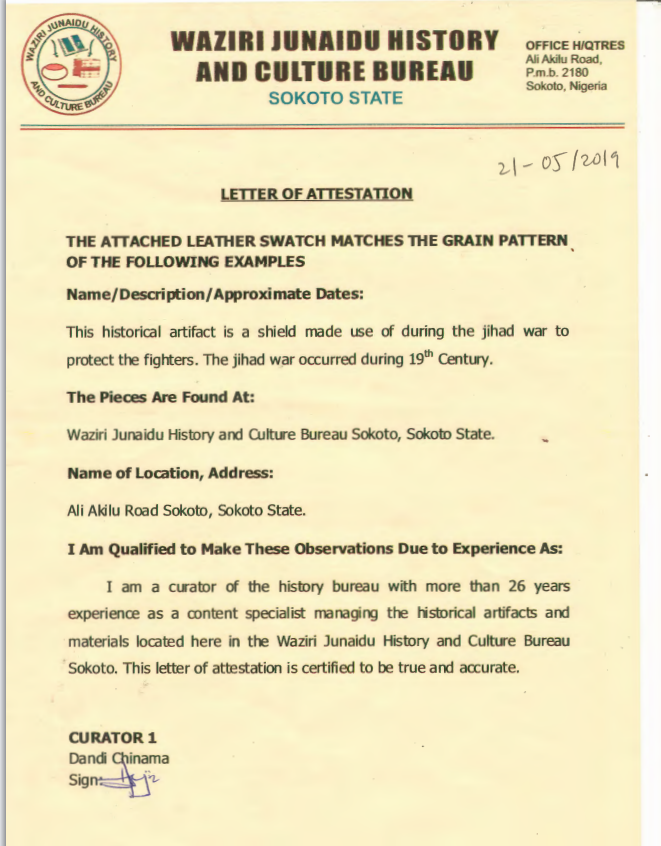
Official certification from Curator Dandi Chinama verifying that a leather swatch matches the grain pattern of a 19th-century Jihad war shield held at the Waziri Junaidu History and Culture Bureau.

Official attestation signed by Director of Culture Bello Hamidu, identifying a leather swatch as matching Sokoto Red Goat file binding used since 1800.
Institutional Trust & Historical Record
- Recognized by the Royal Society of Arts (1905) as the premier vegetable-tanned goat leather
- Trusted by conservation professionals worldwide
- Supplied by Siegel Leather for over two decades of institutional conservation work
Technical Specifications
- Colors: 23 archival aniline colors
- Tannage: 100% vegetable (Bagaruwa & botanical extracts)
- Finish: Full aniline, zero pigment
- Grain: Natural river grain (not embossed)
- Compliance: Sulfur-free, (prior to recoloring), chrome-free, archival-grade
Ideal For
- Archival bookbinding and conservation
- Rare book restoration
- Fine edition publishing
- Gold and blind tooling, particularly gold leaf with albumen
- Institutional and museum collections
The Legacy of Siegel Leather
Our commitment to the craft is built on integrity and a strong ethos of reliability and customer satisfaction. Our over 100 years sojourn reinforces the trustworthiness of Siegel Leather, and ensures that the client trusts and views the material through the lens of a reliable, ethical authority.
The Ethos of Honesty and Trust – Siegel Leather operates on the principle taught by our grandfather, and is epitomized by this Bible verse in Leviticus: “Do not curse the deaf or put a stumbling block in front of the blind, but fear your God.” — Leviticus 19:14 (NIV).
This commitment means:
- Being transparent, fair, and respectful, especially in moments where we hold more knowledge (e.g., explaining why chrome is unacceptable and what the concept archival Leather really means).
- Telling you exactly what our leather is – never calling it vegetable-tanned if it contains chrome, and always explaining the difference between full-grain, aniline, or pigmented finishes.
The Authority Behind the Skin
For over four decades, Steve Siegel Leather has been synonymous with authenticity and quality, serving as an Expert Witness in specialty leathers and supplying institutions like the Harvard Library System and the Smithsonian.
More Than Business: Our Commitment to Ethics, Care, and Community
We believe that being responsible and acting as ambassadors of goodwill goes beyond how we conduct our business, it’s also about how we give back. Alongside our commitment to ethical trade, we are proud to support the communities we serve through meaningful acts of generosity. From charitable gifts to direct community support, including our recent contribution to local girls, we remain dedicated to making a positive, lasting impact where it matters most.

Our Community Development Efforts in Sponsoring a Girl Child in Sokoto .

Letter of commendation for our community development efforts
Final Thoughts
For the professional conservator, elite bookbinder, or fine edition publisher, the choice is clear:
If you seek an imitation, based on surface appearance and manufactured grain, you must look elsewhere. If you require the genuine, historically documented, scientifically proven, and technically superior Sokoto™ Goatskin – backed by the Siegel Leather ethos – we say, Welcome home.